Grahame N's Web Pages
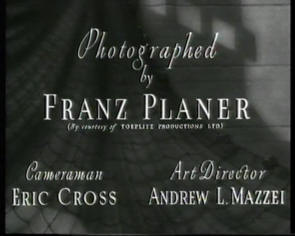
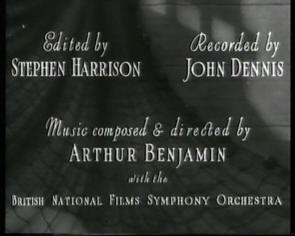
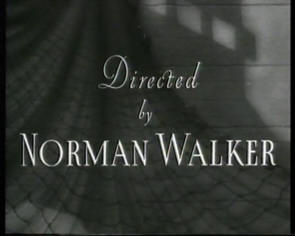
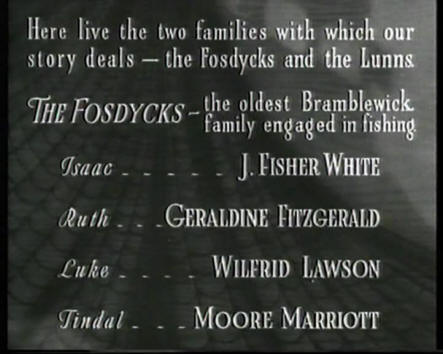
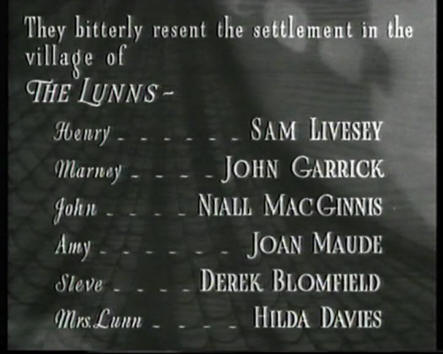
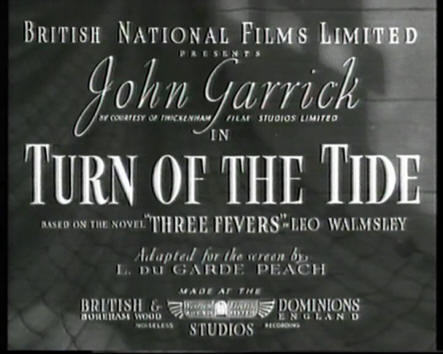
Actual film frames (not from the 9.5mm print though!)
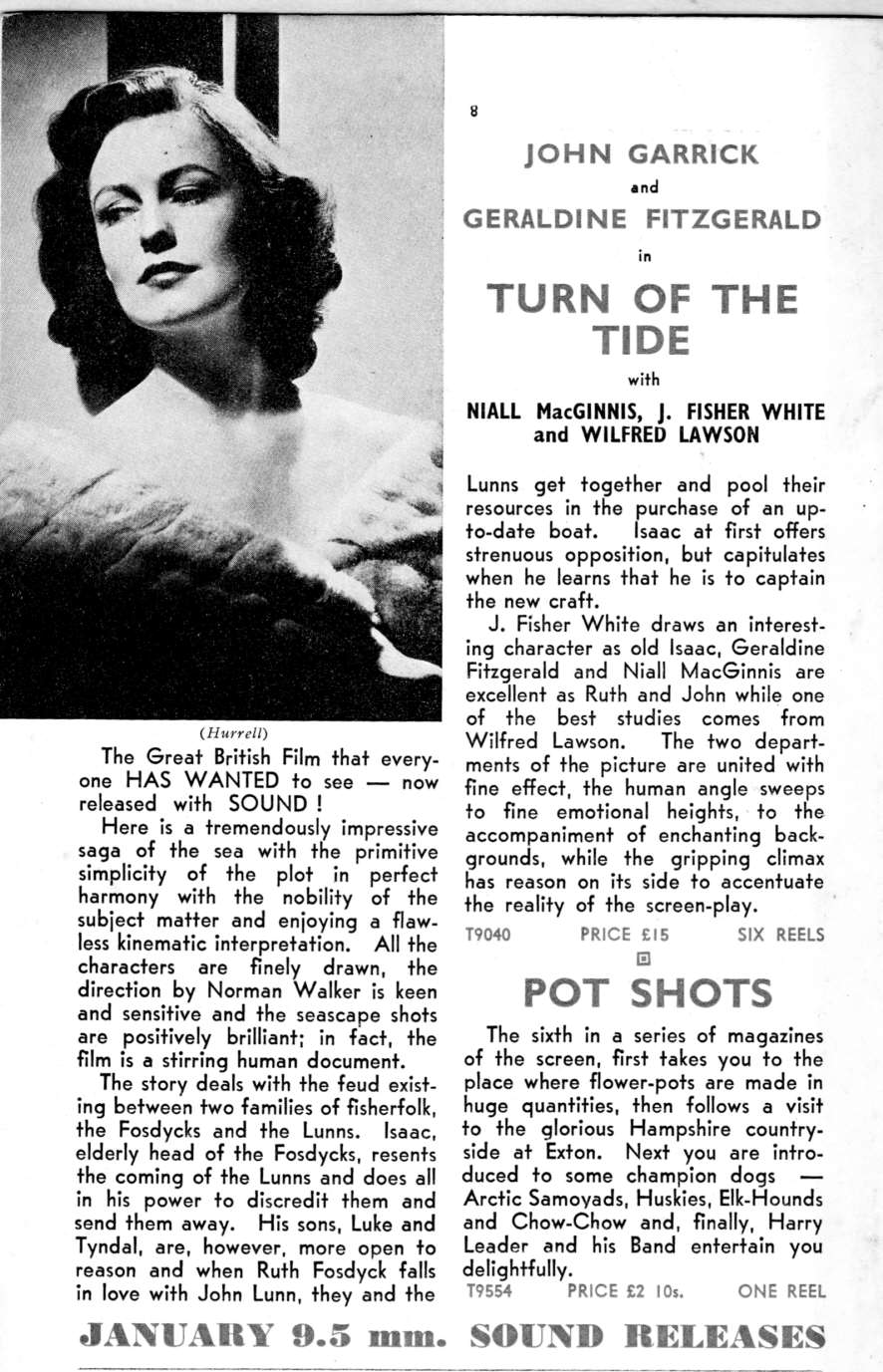
Released by Pathéscope January 1940 on 9.5mm sound as T.9040
(6 reels) - price £15.
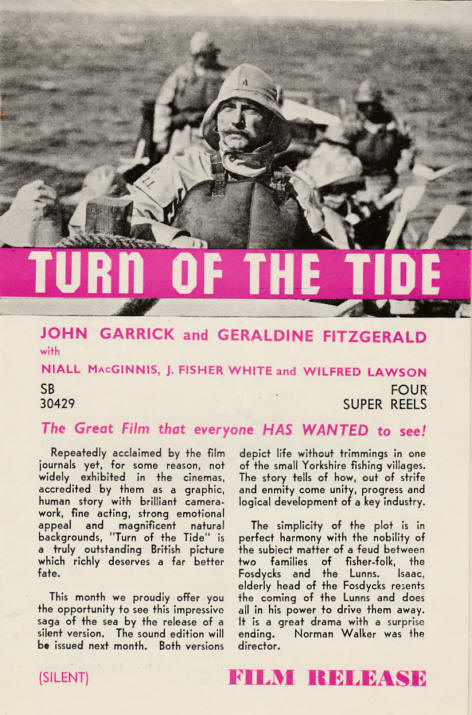
Released by Pathéscope November 1939 on 9.5mm silent as
SB.30429 (4 reels)
"TURN OF THE TIDE" GB 1935      Directed by: Norman Walker
 80 minutes B/W Cert "U"            Produced by: John Corfield
 (approx 50mins on 9.5mm sound)     A British National Films Production
 Released by: Gaumont British Distributors
 Written by: L. Du Garde Peach, J.O.C. Orton
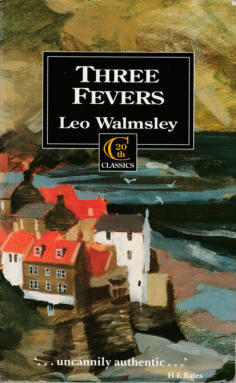
 Based on the novel 'Three Fevers' (1922) by Leo Walmsley
 Dialogue Direction:Tyrone Guthrie
 Photography: Franz Planer
 Art Director: Andrew L. Massei
 Music composed & directed by: Arthur Benjamin
 Edited by: Ian Dalrymple, David Lean


 Cast:
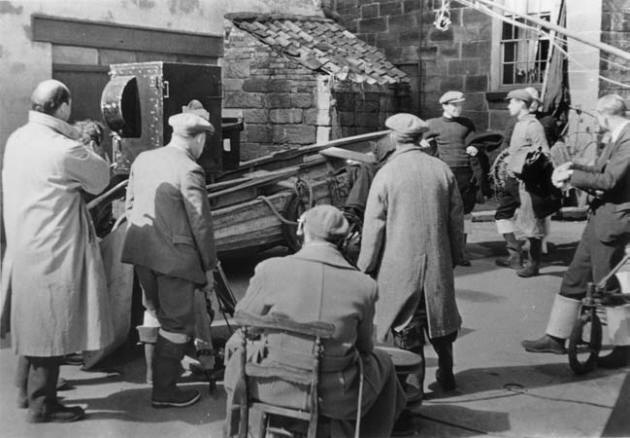
On location
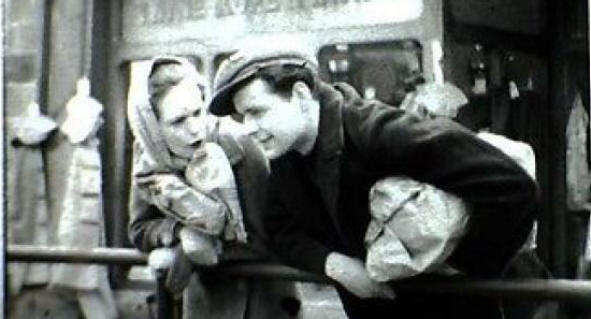
Production still
The arrival in a Yorkshire fishing village of the
Lunns with a modern fishing boat is deeply resented by the
Fosdykes.
Eventually hostilities are overcome and the families join forces
to get a modern deep sea fishing boat (IMDb)
A great feud between the Fosdycks and the Lunns, two
fishing families on the Yorkshire coast, is heightened by the
romance of John Lunn and Ruth Fosdyck. Instead of just using
sail, the Lunns buy a motor for their boat and turn to
fishing for lobster. The discord is settled when the families
join together to buy a new vessel. Old Isaac Fosdyck,
the fiercest opponent of the Lunns, recants and is made skipper.
(Maurice Trace - 9.5mm sound film catalogue)
Screen 9.5 - ‘Turn Of The Tide’ by Maurice Trace
"Turn Of The Tide“ is one of the most
important tilms in the history of the British Cinema. lt was made
in 1935 and a few years later arrived on Nine Five in a Silent
version (4 Reels) and a 6 Reel Sound edition. The movie was based
on the novel "Three Fevers" written in 1922 by Leo
Walmsley. He was brought up in the small fishing community of
Robin Hood's Bay in Yorkshire and obsen/ed the lives of two rival
families, the Storms and the Dukes. Later he fictionalised them
as the Lunns and the Fosdycks in three books called the
Bramblewick Stories. This was the first in the series and the
only one to be filmed - the others were "Phantom
Lobster" and "Sally Lunn". Walmsley also penned
"Foreigners" in which he recalled his childhood in the
village. "Three Fevers", still available in paperback
(Smith Settle), is a splendid read. The author obviously cares
about the people and his writing style, although a little flowery
at times, can be spellbinding.
In the mid-thirties Arthur Rank was a millionaire in the flour
industry. A devout Methodist, he strongly believed in the use ot
Film to spread Religion - so much better than boring sermons! He
organised picture shows and then financially backed productions
with a Christian message. The first ("Mastership") was
made at Merton Park studios in 1934, starred a Methodist minister
and lasted twenty minutes. Later Rank set up British National
Films with two partners - John Corfield, who became managing
director and Lady Yule, widow of a Calcutta jute magnate with an
inheritance of several million pounds. The plan was to produce
quality pictures accurately portraying British Life. The genesis
was a fierce attack by the "Methodist Times" on the low
moral standard of the Cinema. The "Evening News" hit
back saying "lt's all very well finding lault - but why
don't you produce a film that would be suitable for family
showing?" The paper even suggested a suitable book - it was
"Three Fevers"
.
In 1934 Leo received a letter from John Corfield offering to buy
the rights which were sold for the princely sum of £300. The
author was then hired to advise on the production and liase with
the locals for the location shooting that would actually be
around Robin Hood's Bay. L Du Garde Peach and J O C Orton wrote
the screenplay (with input from Walmsley and John Monk) whilst
Norman Walker became director. The plan was to get into the movie
as much natural beauty as possible, but also concentrate on the
human element
.
It was Leo himself who suggested building up the role of old
Isaac Fosdyck, making him a sort of villain, and introducing a
grand-daughter who would fall in love with a Lunn to produce a
Romeo & Juliet type romance. His autobiography, "So Many
Loves", goes into great detail about the production with its
frustrations and the arguments. The original film ran for 80 mins
which appeared on 9.5 Sound as a coherent six reels (around 50
mins). This eliminates the opening 35mm credits and starts with
some of Pathéscope's "Home-Made" titles. Then after
establishing shots of the coast, towns, seas and harbours, we get
the original cast lists - one frame for the Fosdycks, and another
just for the Lunns. The 9.5 print misses the next sequence -
young Sam Lunn having a fight with a gang of lads who consider
his family to be foreigners, although they come from just 20
miles south! Pathescope start with the Fosdycks bringing in their
day's catch and sending it off to market on a truck. Such is the
bad feeling, they will not hold back the vehicle for just a few
minutes for the Lunns to arrive with their haul. However Henry
Lunn with his sons Marney and John is not downcast. The next day
a crate arrives for them - the village watches and wonders. Henry
opens it to display a motor for his boat. The Fosdycks, who use
just sail, look on with interest. The next sequence is missing
from 9.5 as Isaac learns that grand daughter Ruth is courting
John Lunn. In a bitter confrontation with the girl, the old man
threatens all sorts of unishment such as "I'll take a stick
to you". Nine Five resumes as brothers Luke and Tindal
Fosdyck discuss buying a motor themselves, but Isaac harshly
rejects the idea.
Pathéscope sharply cut the following section, but some of the
raw beauty still remains. Both families go out fishing although a
storm is threatening. The Fosdycks soon run for cover, but the
Lunns carry on. There are marvellous shots and excellent
camera-work as the gale lashes the shore and village. The Lunns
still fish, but, fearing the worst, the lifeboat crew is called
out. Eventually Henry cuts the lines and heads for port - only
just getting over the bar. Marney Lunn decides it is time for a
radical change with a move to fishing for lobster. "You've
got lobster fever" shouts his wife (a scene missing on
nine-five). His father and brother agree, but all three start
making pots. Pathéscope cuts out some more pungent exchanges
between old Fosdyck and Ruth, taking up the story again with the
Lunns dropping their brand new pots in the sea. Suddenly John
realises it is Friday - the unlucky day for fishing - but the job
is still completed. However bad luck comes with the arrival of
another storm during the night. The pots are wrecked and washed
up on the beach - Marney inspects a cut rope and suspects the
Fosdycks of sabotage.
Our gauge misses a few more scenes (including father Lunn taking
out a bad tooth with a pair of pincers!) and picks up the story
with the making of more pots. This time the catch is a success.
Pathéscope now eliminate whole sections of family life and Henry
looking at a new boat. It would cost over £1,200 - but could be
bought with a deposit of £500. They would be able to expand into
deep sea fishing - but where can the money come from '2? Nine
five returns as Isaac receives a visitor - the master of a local
tug. He offers the old man £10 for any information on salvage
work, but is turned down as Isaac believes such jobs and reward
should go to the Lifeboat. There is a pleasant interlude when
Marney and Sam go salmon fishing in their best Sunday clothes and
of course fall in the water - but then high drama. In a dense fog
a ship becomes stranded on a sand- bank. The Lifeboat sails to
the rescue, but old Isaac is turned away as there is already a
full crew. Bitter at this treatment, he tips off the tug skipper.
The Lifeboat reaches the beached vessel first and offers to pull
it off the bank. The ship's master is wary, but agrees to their
aid. A line is put aboard and the crew wait for high tide to
refloat the boat. Meanwhile the salvage tug arrives and offers to
take over the job. In a battle of wills the Lifeboat wins out and
succeeds in their task. Later the crew receive their salvage
reward - £50 each. The Lunns tell the Fosdyck brothers about
their plans for a new boat. Luke is interested, but the money
problem is still there. He goes to see Isaac who has just thrown
Ruth out of the house for accepting John Lunn's proposal. In a
tense scene uncle and nephew confront each other. Luke insists
the only way both families can survive is to combine in buying a
new boat. lsaac‘s money would solve the cash problem - and,
if he joined in with his knowledge and skill, he would make an
ideal boss. The old man relents and the film ends with him
skippering a brand new vessel out of harbour as the women wave
from the quay.
A great deal of the film was shot on the Yorkshire coast with
some of the "real" Lunns playing themselves in long
shots - they were paid £5 per week The interiors were at Elstree
where an excellent village set had been built. The premiere of
the film, held at the Empire Cinema in Whitby, saw the
"Lunns & Fosdycks“ plus all the other locals
showering praise on the movie. The "real" Marney
thought it was the best picture that had ever been shown in the
town whilst his father said "Champion". Much of the
credit must go to a very strong cast. The first plans had
included Douglas Fairbanks Junior as Marney Lunn, but this did
not come off and the lead role went to John Garrick - probably
better known for his singing than acting. Fluth was played by
Geraldine Fitzgerald from the Abbey Theatre in Dublin. She soon
went to Hollywood and became a top star, including an Academy
Award nomination for her role in the 1939 "Wuthering
Heights". She had a strong personality and a reputation for
being "difficult", which led to her contract being
suspended several times at the Warners studio. Later Geraldine
became a fine character actress and was still making films in
1991 ("Bump In The Night").
John Lunn is played by Niall MacGinnis - a name familiar to Nine
Fivers for he also took leading parts in "The Last
Adventurers" and "The Edge Of The World".
Like Geraldine, he was lrish and a stage performer. He had a
natural manor of acting and this was the second in a very long
film career lasting until 1981 ("Masada"),
later in strong supporting roles. Moore Marriott (Tindal) is now
best remembered for his parts as a cantankerous old timer in many
Will Hay comedies, such as "Oh Mr Porter“. He
had been in films since 1906 and plenty of his work can be seen
on Nine Five ~ such as "Kitty", "The
Flying Scotsman", "The Black Skull"
and "When Knights Were Bold". Wilfrid Lawson
(Luke) went on to play Doolittle in the acclaimed 1938 "Pygmalion"
with Leslie Howard.
The music, written by Arthur Benjamin, is outstanding, capturing
the mood exactly. He also wrote the scores for many other films,
such as Hitchcock's "The Man Who Knew Too Much"
and penned the lively "Jamaican Rumba“. Praise also to
photographer Franz Planer for some great camera work. He was a
German who came to Britain in the thirties and later had a
successful Hollywood career (as Frank Planer) with credits such
as "Letter From An Unknown Woman" and "The
Big Country". The excellent direction came from Norman
Walker, but Kevin Brownlow recounts there was also input from
David Lean. He had worked as an editor/film doctor during his
early days in the Cinema, but was often not named in the Credits.
He is quoted by Kevin in that fine biography "David Lean“
as working on "Turn" and describing Walker as
"Very pleasant, but not very talented"! David went on
to become one of Britain's top directors ("Brief
Encounter", "Bridge On The River Kwai",
"Laurence Of Arabia" etc). Walker later
directed "The Man At The Gate" which was set
in a Cornish fishing village and included footage from "Turn
Of The Tide" as establishing shots. lt also starred
Wilfrid Lawson who was Luke in the earlier movie and photographed
by Eric Cross, a cameraman on that production.
"Turn Of The Tide" is a splendid film - one of
the best on Nine Five. The critics were full of praise - and it
even won a prize at the Venice Festival. However the bitter
events that followed were to shape the future of the Film
industry for decades. In order to get a country-wide circuit
release, British National had to make an unsatisfactory deal with
Mark Ostrer who ran the Gaumont British cinema chain.
"Turn" went out as the bottom half of a double bill and
brought in only around half the production costs of
£31,928-2s-7d. There was much acrimony with suggestions of
double dealing and false accounting. All this convinced one of
National's directors that "the business had got into the
hands of the wrong people" and in future he must have
control of distribution. The result was the rise to power of J
Arthur Rank and the foundation of his Cinema Empire. Within a
decade he was the biggest force in the British industry, owning
Pinewood studios together with the Gaumont and Odeon chains. The
Rank Organisation was then valued at over fifty million pounds.
If it have not been for this film - and the way he was treated -
then this mild mannered Methodist would probably have remained
unknown. "Turn Of The Tide" was not only the
title of thee movie - it was also a fitting comment on what was
about to happen in the British Film World. (reprinted
from the Group 9.5 magazine No.102 Summer 2000)
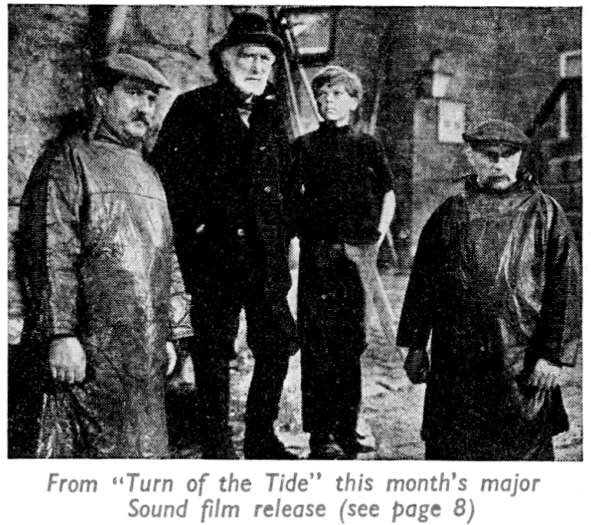
Pathéscope Monthly magazine - Jan1940
Notes:
  1. Based on the 1922 book "Three Fevers" by Leo Walmsley.

  2. Location filming was on the Yorkshire coast at Robin Hood's Bay near Whitby.

  3. The premiere of the film took place at the Empire Cinema in Whitby.

  4. The Pathéscope print omits quite a few sequences, including a fight between young Sam Lunn and a
      gang of lads, several confrontations between Isaac and Ruth, John Laurie taking out a bad tooth
      and Henry looking at a new boat and wondering where he could find money for its purchase.

  5. The first picture to be produced by J. Arthur Rank. It was the initial production of British
     National Fims, a company formed by Lady Yule, John Corfield and Rank to produce quality pictures
     accurately portraying British life.  In order to get a circuit release, they had to make an
     unsatisfactory deal with Mark Ostrer who ran the Gaumont British cinema chain. Although the film
     gained excellent reviews and won a prize at the Venice Film Festival, it went out as the bottom
     half of a double bill with a return of just over half the production costs of £31,928-2sh-7d.
     This convinced Mr Rank that in future he must be able to control the distribution of his films
     - the result was the foundation of the Rank Cinema Empire.

  6. David Lean helped with direction and editing, but doesn't appear on the actual film credits.
(Extra information from the late Dennis Gifford and film historian extraordinaire Maurice Trace)
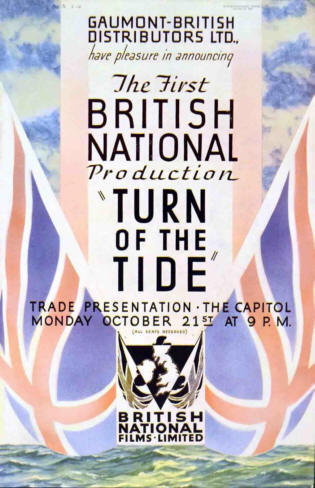
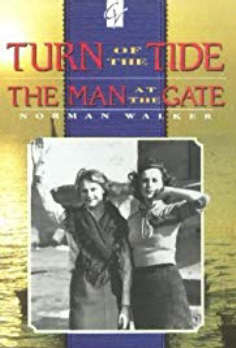
Trade show film poster . . . . . . . . . . Later double
feature film poster
| Look for the original 1922 novel "Three
Fevers" by Leo Walmsley The film itself has
not so far been released on a commercial DVD |
|
Return to: 9.5MM PATHESCOPE SOUND FILM CATALOGUE ........... ALPHA .......... NUMERIC
Return to: 9.5MM PATHESCOPE SILENT FILM CATALOGUE ........... ALPHA .......... NUMERIC
Created 08Nov2019 ...... Last updated: 30 November 2019 ...... 95flmcatt9040.htm ...... ©MMX1X Grahame L. Newnham