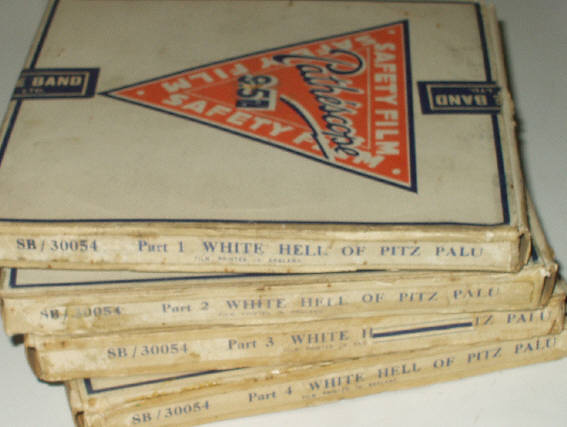
Pathéscope 9.5mm film release
Grahame N's Web Pages
Pathéscope 9.5mm film release
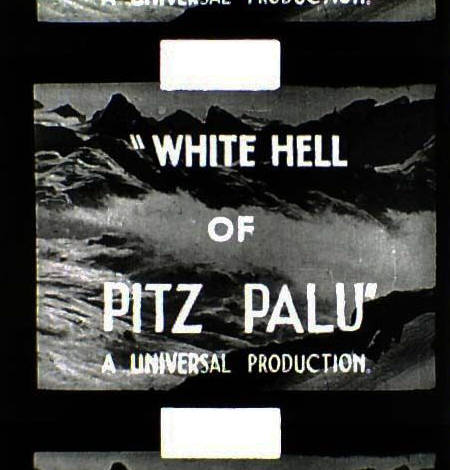
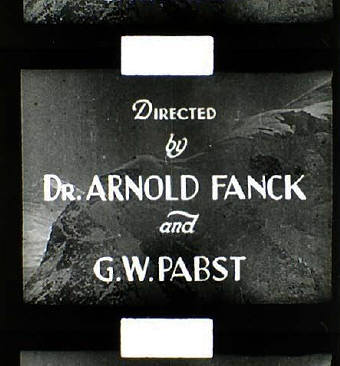
Pathéscope 9.5mm print - main titles
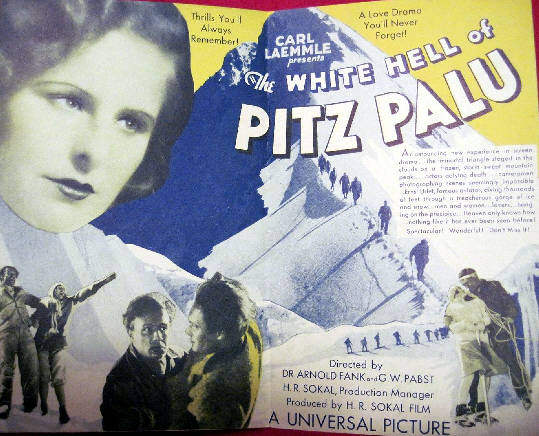
Cinema 'front of house' poster
SB.30054 (4 reels) UK 9.5mm silent film release by Pathéscope - December 1933
(Also released on 9.5mm in Austrian version as 4SB(AU)353 "WHITE HELL OF PITZ PALU"
"WHITE HELL OF PITZ PALU"  GER 18Oct1929     Dir:  Dr. Arnold Fanck and Georg Wilhelm Pabst
------------------------------
Original German title:  "Die Weisse Hölle Von Piz Palü"

150mins (restored 133mins) B/W   Produced by: H R Sokal
(Approx 34 mins on 9.5mm)        Production Company: H R Sokal Film GmbH
                                 Distributed by: Aafa-Film / Universal Pictures
Screenplay by: Arnold Fanck & Ladislaus Vajda  Based on a story by: Arnold Fanck
Photography hy: Sepp Allgeter, Richard Angst & Hans Schnedberger
Art director: Erno Metzner       Editing: Arnold Fanck

(Originally released for the cinema in 1929 as silent, but re-released in 1935 with a music and commentary sound track)
Cast:
     Leni Reifenstahl .......... Maria Brandt
     Gustav Diessl ............. Dr. Johannes Krafft
     Ernst Peterson ............ Hans Brandt
     Otto Spring ............... Christian Klucker (a guide)
     Ernst Udet ................ Captain Ernst Udet (the aviator)
     Mizzi Gotzel .............. Maria Krafft
     Kurt Gerron ............... Guest at Night Club
Charles McNamee ........... Narrator in USA sound version (voice)
Drama - Newly wed Maria
and Hans Brandt are climbing on the lower slopes of Piz Palu, a
treacherous Swiss mountain. They meet the brooding Dr Johannes
Krafft who a year ago on honeymoon lost his wife in an accident
on Palu. He swore to conquer the peak in revenge and has since
roamed the area, becoming known as the "Ghost Of The
Mountain". Against the advice of
Christian, an experienced guide, Krafft decides to tackle the
infamous North Wall alone, but is joined by Hans and then Maria.
A group of students also out climbing are killed by an avalanche.
When Hans breaks his leg, the trio are trapped on a tiny ledge
and overnight hit by a blizzard. In an effort to locate them for
a team of rescuers, ace pilot Captain Ernst Udet flies a
dangerous mission in a small bi-plane through the peaks. During
the night Johannes removes his coat to keep Hans from freezing
and then commitss suicide by falling off the ledge. The Brandts
are found by Udet who guides the rescue party.
(Description from Maurice Trace's fantastic "Guide to
Pathescope Silent 9.5mm Dramas, Thrillers, Adventures and Western
Films")
The Plot (courtesy Wikipedia)
A man climbs a 12,000-foot mountain to search for his wife, who was lost on their honeymoon. Another couple make the dangerous climb with him.
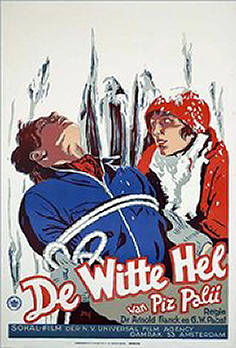
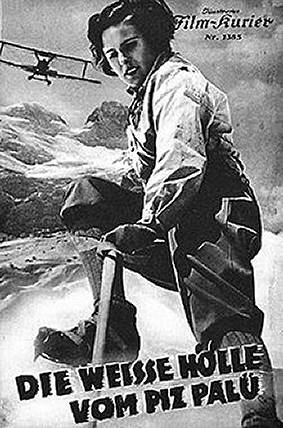
German posters
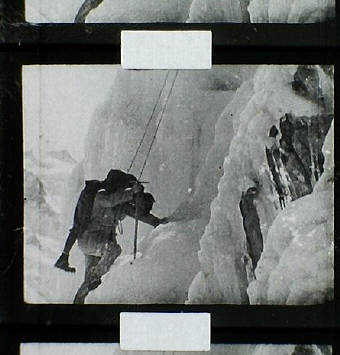
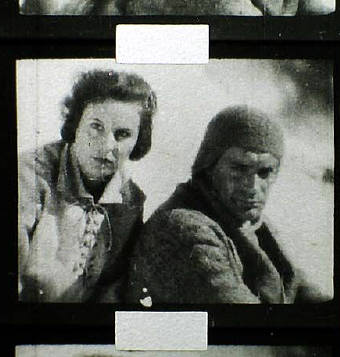
Frames from the 9.5mm print
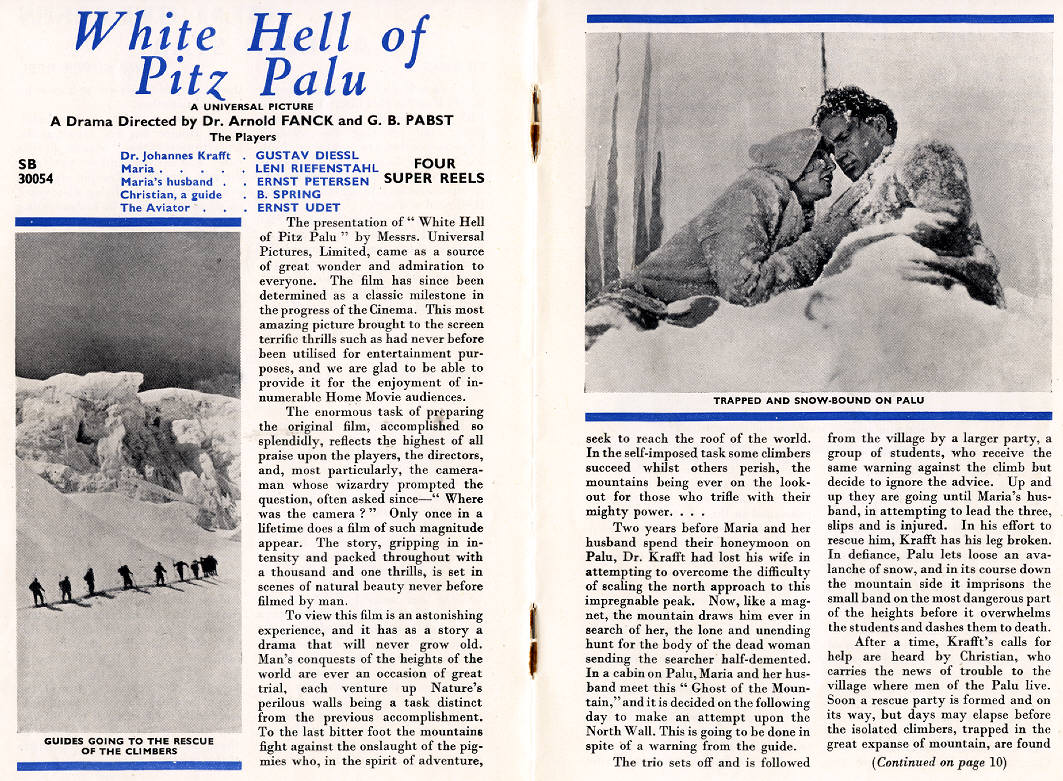
Pathéscope Monthly magazine - December 1933
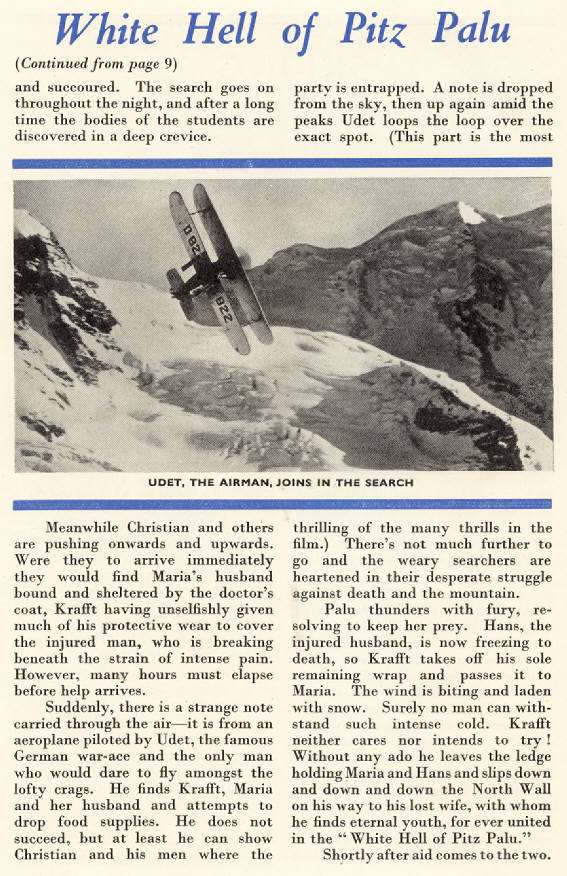
Pathéscope Monthly magazine - December 1933
Pathéscope Monthly magazine - front cover
Text from the 1936 Pathéscope Film Catalogue
 "White Hell Of Pitz Palu" remained listed in the Pathéscope 9.5mm Film Catalogues from 1934,
  up to the post-war illustrated 9.5mm film catalogue dated 1955.
Watch a film trailer for "White Hell Of Pitz Palu" on YouTube - https://youtu.be/FunwKjfFTo8
Notes:

 1. Arnold Fanck directed all the climbing and landscape scenes whilst
    G.B. Pabst handled the story line and interiors.

 2. Location filming took twenty weeks in the Swiss Alps and was shot
    in extreme temperatures and under great hardship.
 3. The film was remade in 1930 with Hans Albers, but shot mainly in a studio.
    In 1933 the original silent was re-issued with a sound track. USA Radio
    Announcer Graham MacNamee provided a "commentary" which included the
    deathless line "Oh Boy, look at that avalanche"!! In 1951 another version
    appeared with Albers again in the lead with support from Adrian Haven
    and Liselotte Pulver. Rolf Hansen was the director.
 4. Much of the outdoor footage was used by the American studio Universal
    in some of their later productions. For example "Flash Gordon Conquers
    The Universe" (1940) included the avalanche scenes and the rescuers
    with fire torches and believe it or not "Lost City Of The Jungle" (1946)
    also contained the torch sequence.

 5. The fantastic flying stunt work is done by Ernst Udet who had been a
    renowned German fighter pilot in the War. A member of the famous squadron
    led by Manfred von Richthofen (alias "The Red Baron"), he recorded 67
    air victories and at only 22 was awarded the "Blue Max", the highest
    military honour. After the Armistice, Udet became a daredevil pilot
    at air shows and in some movies as well as playing a part in the
    development of the famous Stuka dive bomber. Ernst also caused
    controvosy with a campaign alleging Herman Goering made false claims
    of air victories in the War. At the start of the Second World War,
    Udet became a General and head of the Luftwaffe's Technical Office.
    When Germany was defeated by the RAF in the Battle Of Britain, the
    Nazis made Ernst a scapegoat and he was forced to commit suicide in 1941
    by shooting himself. The authorities then claimed he had died while
    testing a new aircraft.

 6. On 11 October 1929 the film premiered in Vienna. In Germany the film
    had its premiere in the same year on November 1 in Stuttgart. The
    official German premiere was on 15 November 1929 in Berlin. In the
    first four weeks the film was seen by more than 100,000 people at the
    UFA Palast in Berlin, at this time Germany's largest and most
    important movie theatre.

 7. During shooting in sub-zero temperatures, Leni Riefenstahl developed
    severe frostbite and a bladder infection that would plague her for
    the rest of her life.

 8. Director Arnold Fanck took the film to Universal Pictures but they
    felt that the script was too thin and turned it down, so Fanck
    financed the production himself.
(Extra Info gratefully added from Maurice Trace, Wikipedia and gln)
 |
An
excellent restoration of the film |
Return to: 9.5MM PATHESCOPE SILENT FILM CATALOGUE ........... ALPHA .......... NUMERIC
Created 12Dec2016 ...... Last updated: 19 March 2017 ......
95flmcatsb30054.htm ......©MMXV1 Grahame L. Newnham
